A Quiet Figure in a Public Family
Trent Grandberry occupies a narrow but notable corner of contemporary family biography. His name appears mainly when discussions turn toward Omarion Grandberry and extended kin. He is not framed as a performer or a chronicled executive. Instead, he emerges as a familial constant with a restrained public silhouette.
That restraint creates a curious effect. The less a person speaks publicly, the more people infer about their inner architecture. Trent becomes legible through presence, not promotion. His public identity therefore feels intimate, almost album like, rather than promotional.
Family Relationships and Public References
The clearest public fact is simple. Trent Grandberry is publicly recognized as the father of Omarion Grandberry, born in 1984. Leslie Burrell is listed as his spouse or partner in public bios. Together, those names form the central axis of his public family profile.
Public references also extend beyond that immediate pair. Some bios mention other children and siblings, though the details vary across accounts. That variation matters, because family records in celebrity circles often shift with repetition. A cautious reader should treat every name with a measured eye.
The family structure also reaches into a newer generation. Publicly referenced grandchildren include A Mei Kazuko Grandberry and Megaa Omari Grandberry. Those names signal continuity across decades. They also show how Trent’s public visibility is often inherited through descendants.
The Limited Public Record
Trent Grandberry has a remarkably sparse professional footprint in public view. Most profiles emphasize relation, not occupation. That scarcity makes him difficult to classify with confidence. It also prevents neat biography from overtaking reality.
There are occasional public mentions of people sharing the same name. Some appear in community or employment contexts. Those references are not enough to establish a single definitive career narrative. As a result, Trent remains partly inscrutable by design and partly obscure by circumstance.
His net worth is not publicly verified in any reliable way. That absence is important. Many celebrity adjacent figures are treated as financial footnotes without evidence. Trent does not appear to have a trustworthy public valuation attached to his name.
A Timeline of Family Markers
Family chronology helps make the portrait more tangible. In 1984, Omarion Grandberry was born. That date is central because it anchors the family in public memory. It also explains why Trent often appears in biographies tied to a son who became famous early.
Another public marker arrives in 2016. That year is associated with the birth of A Mei Kazuko Grandberry. The distance between 1984 and 2016 is more than thirty years. It suggests a family story moving through generational layers rather than a single fame cycle.
Even without a detailed resume, dates still tell a story. They mark beginnings, inheritances, and new branches of a family tree. Trent’s public record is built from these markers more than from career milestones. In that sense, his timeline is relational before it is occupational.
Why the Family Patriarch Archetype Fits
Trent fits the classic archetype of the quiet patriarch. He appears in the background, yet the background remains structurally important. Films often use such figures to stabilize a scene. Real families do this without any script at all.
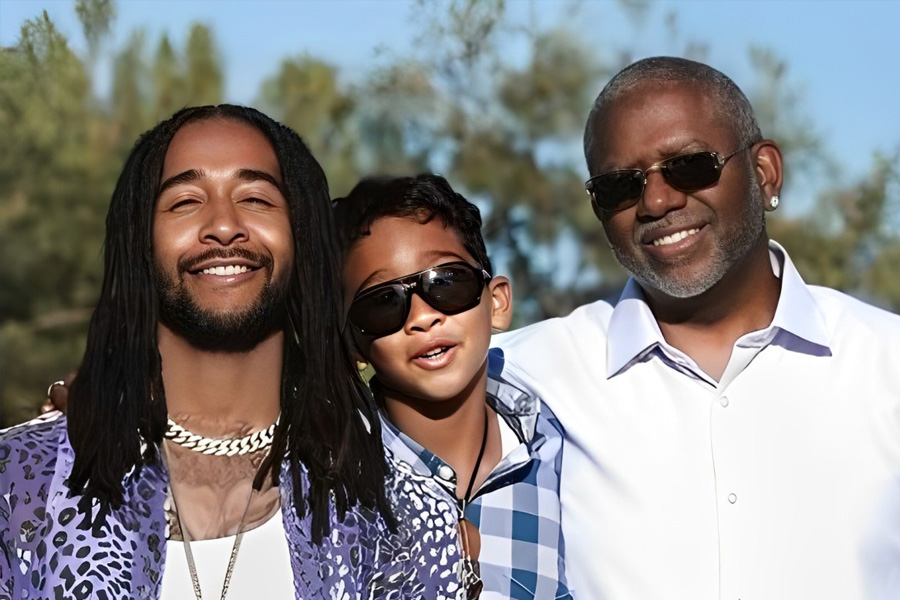
The image is almost cinematic. A hand on a shoulder can communicate allegiance faster than speech. A family photograph can imply discipline, warmth, or continuity in a single frame. Trent’s public presence works through that kind of visual shorthand.
People often search for dramatic narratives around celebrity families. They expect conflict, ambition, or revelation. Trent’s profile offers something less sensational and more durable. It offers steadiness, proximity, and the suggestion of private stewardship.
Public Life Without a Loud Platform
Not every person near fame becomes a brand. Some remain private while living beside public attention. That reality can be difficult for gossip driven culture to absorb. Yet it is often the most honest arrangement.
Trent’s limited exposure may be intentional, ordinary, or both. He appears mainly in family contexts and public photos. Those glimpses are enough to establish recognition, but not enough to manufacture a full mythology. The result is a life visible at the edges, not the center.
This kind of visibility has a peculiar dignity. It allows family to remain family rather than becoming content. It also reminds readers that public relevance has many shapes. Some are loud, and some are quietly foundational.
Intergenerational Continuity
The public story around Trent is deeply intergenerational. Omarion’s 1984 birth marks one stage. The later birth of A Mei Kazuko Grandberry marks another. Between those moments lies a family that has grown under public observation.
Intergenerational families often develop a layered public texture. One generation’s fame casts light on another generation’s privacy. Another generation then adds fresh interest and fresh names. Trent stands near the center of that evolving pattern.
These family layers also help explain why his name still circulates. People often encounter him through children, grandchildren, and family appearances. In that sense, his public life is cumulative. It accrues through kinship rather than career headlines.
The Problem of Name Overlap
A practical caution is necessary here. Multiple people share similar names. That makes public references less stable than they first appear. A casual search can easily merge separate identities.
This is why restraint matters when discussing Trent Grandberry. Not every mention belongs to the same person. Some references may point elsewhere entirely. Careful reading preserves accuracy and respects the limits of the available record.
The ambiguity also reveals a broader truth. Public archives are not always tidy, especially around private individuals. Names can echo across unrelated contexts. Trent’s profile therefore requires humility, not overreach.
Key Takeaways
Trent Grandberry is publicly known primarily through family connection. He is recognized as the father of Omarion Grandberry, born in 1984. Leslie Burrell is listed as his spouse or partner in public bios. Publicly referenced grandchildren include A Mei Kazuko Grandberry and Megaa Omari Grandberry.
His professional background remains largely undocumented in reliable public view. No trustworthy net worth figure is publicly established. Most available mentions place him in family scenes rather than career narratives. That makes him a distinctly private figure within a highly visible family.
The most accurate portrait of Trent is therefore restrained. He is a quiet presence, a relational anchor, and a recurring figure in family memory. His significance comes from continuity rather than spectacle.