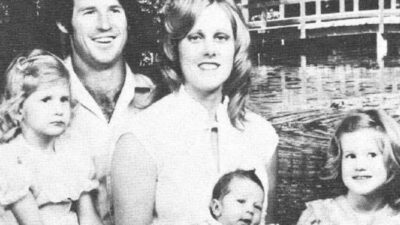
Early Displacement and Childhood
Rhett Broderick was born on February 7, 1979, in Idaho, United States. He entered a family already burdened by public strain and domestic rupture. His father was Daniel T. Broderick III, and his mother was Elisabeth Anne Broderick. The household had already been fraying by 1985. That year marked the start of a divorce that would later become nationally notorious. Rhett was the youngest of four surviving children. He also had one brother who died shortly after birth. His early years unfolded beneath an atmosphere of instability, publicity, and emotional abrasion.
The family tragedy intensified on November 5, 1989. That day, Betty Broderick killed Daniel Broderick and his second wife, Linda Kolkena, in San Diego. Rhett was still a child when that violence entered his life. The event transformed private grief into public spectacle. Court records, media coverage, and later retrospectives kept the family name in circulation. For a child, such exposure can be corrosive and disorienting. Rhett’s early environment offered little ordinary continuity. He had to grow within a storm he did not create.
Custody and Recovery
After the murders, Rhett did not remain in any simple or settled arrangement. His life became itinerant for a period. He moved among relatives and structured settings that could provide stability. By February 1992, he and his brother Daniel Jr. were placed under the permanent custody of an aunt in Colorado. That transition mattered. It created a more predictable framework after years of upheaval. Routine can seem trivial from the outside. For children shaped by trauma, it can be restorative and indispensable.
Rhett gradually withdrew from the public glare. He did not become a constant subject of media performance. Instead, he gravitated toward school, athletics, and quieter community life. Those choices suggest a practical temperament. He appears to have preferred competence over spectacle. That inclination later defined his career. The child from a high profile family became an adult who valued ordinary usefulness. In many lives, that is a difficult but meaningful restoration.
Education and Intellectual Direction
Rhett’s academic path reveals deliberate reconstruction. He studied geography at the University of California, Berkeley, and earned a BA in 2005. Geography is an apt field for someone whose childhood was marked by movement and unsettled place. It studies landscapes, human patterns, and spatial relationships. Those concerns can appeal to a person trying to order a fractured world. He later pursued a master’s degree in secondary education at Oregon State University, finishing in 2016. That second degree signaled a shift from study to service. It also sharpened his work in classrooms and athletics.
His education spans both 2005 and 2016, two dates that frame an adult formation. The interval between them was not idle. It included years of teaching, coaching, and practice. He built expertise in real institutions, with real adolescents, under real constraints. That matters more than abstraction. A teacher with experience in multiple settings often develops unusual durability. Rhett seems to have done exactly that. He took a difficult beginning and turned it into vocational coherence.
Professional Life in Schools
Rhett has worked as a high school teacher and coach. Since 2016, he has been at Wood River High School in Hailey, Idaho. His teaching areas include English for grades 9 through 11, Leadership, World History, US History, and AP Human Geography. That range is broad but still disciplined. It combines humanities, civic formation, and geographic literacy. Such a schedule requires flexibility and stamina. It also requires patience with adolescent volatility.
His coaching work includes football and skiing. Those two sports reflect different climates and different forms of rigor. Football demands structure, repetition, and collective rhythm. Skiing requires balance, terrain sense, and technical confidence. Together they imply a teacher comfortable with both classroom and field. Earlier in his career, he worked as a ski and snowboard instructor and race coach at Sierra-at-Tahoe from 2000 to 2003. He later taught history, coached football, and served as a dorm parent at Dunn School from 2007 to 2009. From 2009 to 2015, he taught humanities and AP Human Geography at Vistamar School. The chronology shows steady progression, not opportunism.
| Years | Role | Organization | Location |
|---|---|---|---|
| 2000 to 2003 | Ski and snowboard instructor, race coach | Sierra-at-Tahoe | California |
| 2007 to 2009 | History teacher, football coach, dorm parent | Dunn School | Los Olivos, California |
| 2009 to 2015 | Humanities and AP Human Geography teacher | Vistamar School | El Segundo, California |
| 2016 to present | Teacher, football coach, ski coach | Wood River High School | Hailey, Idaho |
Family Life and Private Rhythm
Rhett is married to Veronica Noffke, an educator. They have two daughters. Public descriptions of his domestic life emphasize restraint and privacy. That restraint seems deliberate, not accidental. Some families cultivate public visibility as a habit. Others defend a quieter perimeter. Rhett’s family appears to prefer the latter. Their life in Hailey, Idaho, is shaped by school schedules, sports, and mountain weather. Those rhythms are modest, but they are not thin. They give structure to ordinary days.
His residence in Hailey places him in a community known for proximity to alpine recreation and small town continuity. The setting suits a person who coaches skiing. It also suits someone who wants distance from inherited notoriety. Low public visibility can be a form of self protection. It can also be a mark of discipline. Rhett’s life in Idaho suggests both. He does not appear to court attention. Instead, he invests in local roles that carry weight without spectacle.
The Broderick Family Burden
The Broderick family name remains tied to one of the most widely discussed criminal cases of the late 20th century. Daniel T. Broderick III, a medical malpractice lawyer, died in 1989. Betty Broderick was convicted in 1991 of two counts of second degree murder. She received a sentence of 32 years to life. Her parole hearings continued to draw attention across decades. That meant the family’s private history kept reentering public conversation.
Rhett’s siblings have held differing positions over time. Kim Broderick was born in 1970. Lee, also called Kathy Lee, was born in 1971. Daniel Jr. was born in 1976. Their responses to the family history have not been identical. Some have expressed caution regarding Betty’s release. Rhett has publicly conveyed a more nuanced view, saying she is not a danger to society. That position does not erase the past. It suggests a specific moral orientation shaped by years of distance and reflection. Family memory can harden into doctrine. It can also become more complicated with age.
| Family Member | Relation | Notable Detail |
|---|---|---|
| Daniel T. Broderick III | Father | Died in 1989 |
| Elisabeth Anne Broderick | Mother | Convicted in 1991 |
| Kim Broderick | Sister | Elder sibling |
| Lee Broderick | Sister | Privacy minded |
| Daniel Broderick Jr. | Brother | Older sibling |
| Veronica Noffke | Spouse | Educator |
| Two daughters | Children | Names kept private |
Parole, Memory, and Public Position
The years 1990, 1991, 2010, and 2017 mark recurring legal and emotional intervals for the Broderick family. Court proceedings in the early 1990s established the legal aftermath. Later parole hearings revived the question of forgiveness versus caution. For the children, those hearings were not abstract civic exercises. They involved memory, loss, and the problem of future risk. Rhett’s position in 2010 was notably pragmatic. He argued that continued incarceration was not helping Betty and that she posed no threat to society. That view stands in contrast with other family members who were less receptive.
These disagreements reveal something important. The family did not collapse into a single emotional script. Each sibling developed a distinct relation to trauma. That is common in long aftermaths. People who share a catastrophe often diverge in interpretation. One sibling may seek permanence through punishment. Another may seek peace through release. Rhett’s stance belongs to the latter impulse, though it remains carefully bounded. He does not read as sentimental. He reads as someone who has lived too long with irreducible facts.
Life in Hailey
Hailey, Idaho gives Rhett a setting far removed from the old media cycle. Community events, school routines, and seasonal recreation define the social climate. He has made occasional public appearances, but his general pattern remains low key. A 2025 Beer Olympics win briefly pulled his name into local conversation. That moment was lighter than the family history that often shadows him. It also showed how local life can generate its own small fame. For someone with a difficult surname, that kind of brief, communal recognition may be preferable.
His public presence is limited. Social media activity appears sparse. Most online references to his name remain tied to the broader Broderick case. That scarcity is informative. In an age of constant self disclosure, restraint becomes legible. Rhett seems to favor teaching, coaching, and private family life over commentary. That preference fits the arc of his adulthood. He has not tried to convert notoriety into personal brand capital. He has used his energy elsewhere.
Key Takeaways
Rhett Broderick’s life is best understood as a long exertion toward normalcy. He was born into a family ruptured by divorce and later violence. He endured custody changes, public scrutiny, and a legally charged family legacy. Yet he built a professional identity in education and athletics. His degrees from UC Berkeley in 2005 and Oregon State University in 2016 support that trajectory. His work at Wood River High School in Hailey shows consistency over flash.
He teaches multiple subjects, coaches football and skiing, and raises two daughters with Veronica Noffke. His public posture is quiet and measured. He engages the family history without becoming trapped inside it. That combination of diligence, reserve, and adaptability defines his adult life.